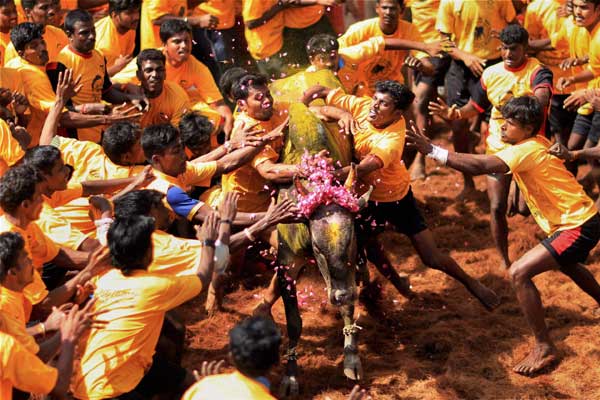
There are various misconceptions about the traditional sport Jallikattu also known as Eru thazhuvuthal and Manju virattu. Here we attempt to bring out the details of the sport, it's History and Tradition.
An Indian Tradition Jallikattu has been organised since the times of Indus valley civilization and there are unearthed artifacts depicting the game. In the last few days, thousands of students and young professionals have gathered across Tamil Nadu in order to protest against the ban on Jallikattu. It is our right to follow our tradition and we are the ones responsible to preserve it.
 |
| Source : The Hindu ; Eru Thazhuvuthal Found in a Perumal temple of 17th century, Tuticorin dt. |
 |
| A painting depicting Krishna taming a bull and an artifact depicting Jallikattu |
The Game
Now lets know about this game. Jallikattu is also known as Eru Thazhuvudhal which literally means embracing the bull. Jallikattu is an annual event and is organised on the day of Maattu Pongal, that is the day following the main Pongal. The goal of the participant in this game is to either hold on to the hump of the bull for a certain duration or pluck the bag of coins which is tied to its horns and tame it. The most virile bulls remains untamed and is identified for servicing the cows in the village. This ensures that the offsprings are of superior nature. Thus, Jallikattu has helps the farming community preserve their native breeds.
 |
| Source: jallikattu.in/ ; Jallikattu: The warrior sport |
Rearing the bull for Jallikattu
When a new bull takes birth,the farmer takes decision whether the bull can be used for Jallikattu. If it is fit for the game, they give it nutritious fodder and in order to make its legs stronger, swimming is taught. They spend more for the bull than what they spend for themselves. These bulls aren’t used for any other purposes such as ploughing or transportation.
How is Jallikattu organised?
Jallikattu has its own set of rules which is strictly followed, especially after the enactment of Jallikattu Act in 2009 by the state government of Tamil Nadu. In Jallikattu, participants must not hold anything other than the hump of the animal. At a time, only one person should hold the bull. Before starting the game, the health of the bull and that of the players is checked by the government veterinary doctors in the presence of district collector. The player arena and the spectators stands are clearly demarcated and separated from each other. Bulls were never injured, though the participants got injured several times. If a bull is injured, the whole event would be called off. The whole event is video recorded and submitted to the government. Spectators think that the bull is enraged by players, but the truth is that it is trained to run towards its owner who stands on the other side of the arena. The total time that a bull spends in the arena is just a few minutes. Therefore it is clear that Jallikattu is not cruel to the bulls. As far as players are concerned, they must be given protective gear. Thus, blanket ban of the game must not be enforced.
The importance of preserving our native breeds
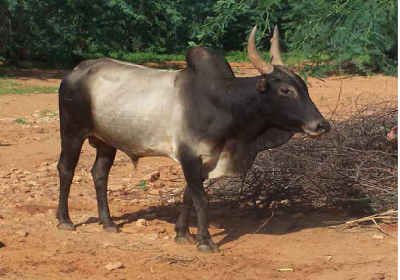
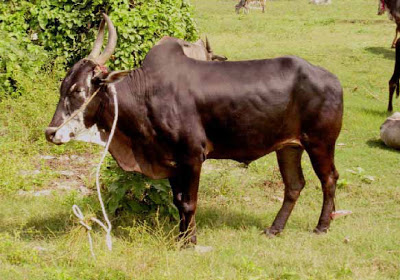
Now lets understand, why should we preserve our native breeds. In India, there were 130 native breeds of bulls, but now there are only 30 breeds. Out of these Tamil Nadu had 6 native breeds, but one of them has already become extinct. They are Puliyakulam, Alambadi, Maalai Maadu, Upalachery, Kangeyam and Barguru. Among these Puliyakulam was used for Jallikattu in Madurai belt, Kangeyam was used for Rekla races in Coimbatore belt. Each breed was preserved by organising a sport based on its anatomy. Earlier for every 4 cows there was 1 bull, but now for 8 cows there is only one bull.
 |
| Source: TNAU ; Gir - Native Breed |
 |
| Source: TNAU ; Kangeyam - Native Breed |
Cross breeding started in India in 1950s during the time of White revolution. India was milk deficient and in order to increase the production, jersey cows were imported and cross bred with native varieties. Cross bred cows gave 4500 liters of milk per breeding whereas native breed gave only 2500 liters of milk per breeding. This made our officials to promote Jersey cows among our farmers. But when we consider the overall lifetime period of cows,our native breed can give up-to 30,000 liters of milk whereas the imported ones can give only 18,000 liters. This realization came very late.
Also jersey cows have to be environmentally stabilized to get adapted to our conditions. Moreover they consume more water and require special fodder. This is quite impossible for a marginal Indian farmer to afford.
The most important reason for preserving our native breeds is that most of our native breeds produce A2 type of milk which contains the necessary proteins for curing our diseases, whereas research shows that the imported breeds produces A1 type of milk which on the contrary causes diseases such as autism and obesity among the consumers. The sad news is that the cross bred cows produce A1 milk.
Capitalism in Indian Dairy Industry
Milk industry is a very big industry in India, much larger than any other food product. Milk also remains to be the main source of proteins for the millions of vegetarians in India. Looking at the huge market, multinational companies are trying to enter our market. They want to sell their Jersey cows, semen and A2 milk at prices dictated by them. If we preserve our native breeds, we can be independent and Jallikattu is one ancient tradition which does that. If Jallikattu ban is not evoked, then farmers might not be in a position to raise their bull and they might end up sending it to slaughter houses.


We might end up importing our milk and cows if we don’t preserve our native breeds
In Tamil Nadu, cows and bulls are considered as one of their own family members. They are taken proper care of and are worshiped as god. I request all of you to support Jallikattu and help preserve our native breeds.
Jai Hind.
- B. Ashwin Kumar and K. Kamalnath
(B. Ashwin Kumar is an M.Tech Infrastructure Engineering Design student. Completed B.Tech Energy and Environmental engineering. His Area of interests are Renewable energy, Smart Cities, Sustainability. ashwink771
(K. Kamal Nath is also an Energy and Environmental Engineer, His area of interest is to spread awareness in his field. tweet@KamalNath95)