Showing posts with label Environment. Show all posts

Monday, 23 January 2017

(Sequel of article: Hidden face of Agriculture- Bitter Truth by Ramsundar)


If we get into time machine and go back, we can recall that women is the one who introduced settled agriculture while men were still hunters and gatherers. Ironically, In present scenario, the women turned out to be a hidden face of Agriculture.  She is masked by rigid societal practices, cultural taboo, rigid rules of lands.  Despite that she emerges as a sprout of hope.


We cannot disagree that women make important contribution to rural economy as Farmers, agricultural labourers and entrepreneurs.  Small scale farming, micro enterprises and cottage industries constitute the largest self employment sectors in India.  FAO (Food and Agricultural Organisation) states that promoting gender equality is not only good for women, it is also good for agriculture development.


Now, rural women farmers are involved in hybrid seed production through seed village concept, they use Information and communication technology tools, with Jan Dhan Yojna they entered into formal financial structure. Successful women farmers take the benefits of crop diversification by shifting to floriculture crops which gives them added profit through value addition like veni making, garland making, etc., Similarly apiculture, animal husbandry, food processing, sericulture are other fields in which the women farmers are reaping huge benefits.
HFA imot forum nive photo
Picture credit : Nivendran


When women gets additional income, it is true that they spend more of it in food, health, clothing and education for their children  men.  This has short term benefits for their family well being and in long term for national development.


Now, “Organic farming” becomes a buzzword everywhere. Women are saviour of organic farming. Traditionally, Women are considered to be the seed preservationists.  Their support in cattle rearing reading is important for generation of organic inputs.  Similarly, the Peri-urban vegetable farming, rooftop gardens, kitchen gardens in urban areas are dominated by female. This shows the healthy change of status of women in both urban and rural agriculture.


The National Commission on Farmers also dealt with issue of Feminization of poverty and agriculture in detail and in its report suggested setting up of creches, day care centres and other support services for women farmers and farm labourers. At the same time economic interests of women are safeguarded through Self Help Group (SHG) movement and Cooperatives.


At the same time, Government schemes like Mahila Kisan Sashaktikaran Pariyojna (MKSP), as a subcomponent of NRLM (National Rural Livelihood Mission) was started to enhance productive participation of women in agriculture and to create livelihood opportunities for women in agriculture.  Additionally, MGNREGS (Mahatma Gandhi National Rural employment Guarantee scheme) is reported to have increased the farm income of women agricultural labourers.
snap shot of MKSP home page


Similarly various state government scheme targets deprived women and tribal women like Mahalir thittam of Tamil Nadu which make credit accessible to women through Self Help Groups in addition to employment generation.


As a whole, Though the changing trend brings Women, The hidden face of Agriculture in limelight it should be aggregated in all spheres.  Discrimination under law must be reduced. Women farmers should be provided with equal access to resources and opportunities. Government would come forward with gender inclusive policies, gender responsive budgeting in agriculture.  This will result in agriculture development and also women empowerment.

(M. Ram Sundar is a Horticulture graduate.  He is interested in writing and reading books. He is also the admin of IMoT forum. sundar.ram94@gmail.com  )

Picture credits: Nivendran

Saturday, 21 January 2017

There are various misconceptions about the traditional sport Jallikattu also known as Eru thazhuvuthal and Manju virattu. Here we attempt to bring out the details of the sport, it's History and Tradition.

An Indian Tradition
Jallikattu has been organised since the times of Indus valley civilization and there are unearthed artifacts depicting the game. In the last few days, thousands of students and young professionals have gathered across Tamil Nadu in order to protest against the ban on Jallikattu. It is our right to follow our tradition and we are the ones responsible to preserve it.

Source : The Hindu ; Eru Thazhuvuthal Found in a Perumal temple of 17th century, Tuticorin dt.
A painting depicting Krishna taming a bull and an artifact depicting Jallikattu

The Game

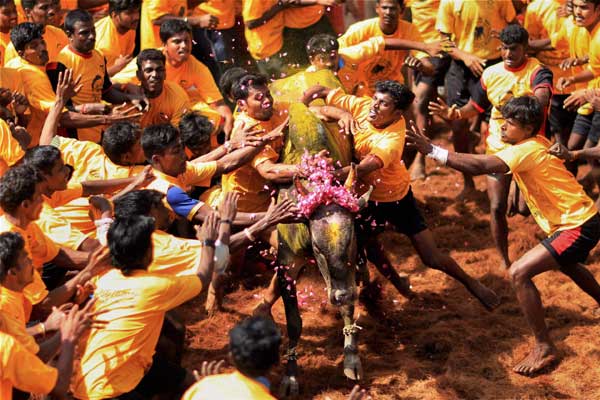
Now lets know about this game. Jallikattu is also known as Eru Thazhuvudhal which literally means embracing the bull. Jallikattu is an annual event and is organised on the day of Maattu Pongal, that is the day following the main Pongal. The goal of the participant in this game is to either hold on to the hump of the bull for a certain duration or pluck the bag of coins which is tied to its horns and tame it. The most virile bulls remains untamed and is identified for servicing the cows in the village. This ensures that the offsprings are of superior nature. Thus, Jallikattu has helps the farming community preserve their native breeds.

Source: jallikattu.in/ ; Jallikattu: The warrior sport

Rearing the bull for Jallikattu

When a new bull takes birth,the farmer takes decision whether the bull can be used for Jallikattu. If it is fit for the game, they give it nutritious fodder and in order to make its legs stronger, swimming is taught. They spend more for the bull than what they spend for themselves. These bulls aren’t used for any other purposes such as ploughing or transportation.

How is Jallikattu organised?

Jallikattu has its own set of rules which is strictly followed, especially after the enactment of Jallikattu Act in 2009 by the state government of Tamil Nadu. In Jallikattu, participants must not hold anything other than the hump of the animal. At a time, only one person should hold the bull. Before starting the game, the health of the bull and that of the players is checked by the government veterinary doctors in the presence of district collector. The player arena and the spectators stands are clearly demarcated and separated from each other. Bulls were never injured, though the participants got injured several times. If a bull is injured, the whole event would be called off. The whole event is video recorded and submitted to the government. Spectators think that the bull is enraged by players, but the truth is that it is trained to run towards its owner who stands on the other side of the arena. The total time that a bull spends in the arena is just a few minutes. Therefore it is clear that Jallikattu is not cruel to the bulls. As far as players are concerned, they must be given protective gear. Thus, blanket ban of the game must not be enforced.

The importance of preserving our native breeds

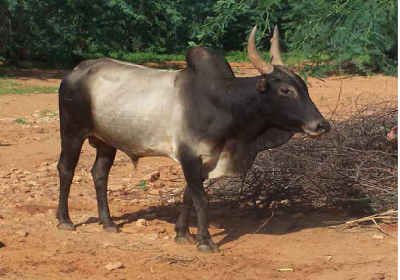
Now lets understand, why should we preserve our native breeds. In India, there were 130 native breeds of bulls, but now there are only 30 breeds. Out of these Tamil Nadu had 6 native breeds, but one of them has already become extinct. They are Puliyakulam, Alambadi, Maalai Maadu, Upalachery, Kangeyam and Barguru. Among these Puliyakulam was used for Jallikattu in Madurai belt, Kangeyam was used for Rekla races in Coimbatore belt. Each breed was preserved by organising a sport based on its anatomy. Earlier for every 4 cows there was 1 bull, but now for 8 cows there is only one bull.

gir
Source: TNAU ; Gir - Native Breed


Source: TNAU ; Kangeyam - Native Breed


Cross breeding started in India in 1950s during the time of White revolution. India was milk deficient and in order to increase the production, jersey cows were imported and cross bred with native varieties. Cross bred cows gave 4500 liters of milk per breeding whereas native breed gave only 2500 liters of milk per breeding. This made our officials to promote Jersey cows among our farmers. But when we consider the overall lifetime period of cows,our native breed can give up-to 30,000 liters of milk whereas the imported ones can give only 18,000 liters. This realization came very late.

Also jersey cows have to be environmentally stabilized to get adapted to our conditions. Moreover they consume more water and require special fodder. This is quite impossible for a marginal Indian farmer to afford.

The most important reason for preserving our native breeds is that most of our native breeds produce A2 type of milk which contains the necessary proteins for curing our diseases, whereas research shows that the imported breeds produces A1 type of milk which on the contrary causes diseases such as autism and obesity among the consumers. The sad news is that the cross bred cows produce A1 milk.

Capitalism in Indian Dairy Industry

Milk industry is a very big industry in India, much larger than any other food product. Milk also remains to be the main source of proteins for the millions of vegetarians in India. Looking at  the huge market, multinational companies are trying to enter our market. They want to sell their Jersey cows, semen and A2 milk at prices dictated by them. If we preserve our native breeds, we can be independent and Jallikattu is one ancient tradition which does that. If Jallikattu ban is not evoked, then farmers might not be in a position to raise their bull and they might end up  sending it to slaughter houses.

We might end up importing our milk and cows if we don’t preserve our native breeds

In Tamil Nadu, cows and bulls are considered as one of their own family members. They are taken proper care of and are worshiped as god. I request all of you to support Jallikattu and help preserve our native breeds.
Jai Hind.

- B. Ashwin Kumar and K. Kamalnath

(B. Ashwin Kumar is an M.Tech Infrastructure Engineering Design student. Completed B.Tech Energy and Environmental engineering. His Area of interests are Renewable energy, Smart Cities, Sustainability. ashwink771@gmail.com)
(K. Kamal Nath is also an Energy and Environmental Engineer, His area of interest is to spread awareness in his field. tweet@KamalNath95)

Thursday, 19 January 2017

It was heartbreaking to see the discussions/debates about Jallikattu in Prime National News channels.They had narrowed down the debate on Jallikattu to just a matter of Tamil pride Vs Animal right activists or Culture first Vs People first or Tamil tradition Vs Animal cruelty.  Even they have narrowed down the Student protest to Peta Vs Pro Jallikattu activistsTo them and to the greater world I feel to say “Jallikattu protest of Youths” is not just a matter of Tamil Pride and we rise the voice against the underhanded Globalisation, shady Neocolonisation, selfish Corporates and insensitive political setup that form a whole web of complication behind Jallikattu and incidentally we took this as a spark, get ourselves ignited to burn the obstacle before us.


j 1.jpg
Source: PTI

Jallikattu - Matter of Agricultural importance:

All over the world, agricultural community and animals are seen as partners. Bulls are integral part of farming, especially for small and marginal farmers as they serve multiple purposes like ploughing, transportation, source for farmyard manure, panchagavya, jeevamrutham, and as a source of A2 milk.  With most of the farmers switching to Organic farming and sustainable agriculture, Native cattles are of much more importance. When local farmers are feeling the brunt of climate change and Monsoon failures the native cattle are both an input as well as insurance to the livestock keepers.

Agricultural community and livestock keepers are creators of breeds and custodians of animal genetic resources for food and agriculture says Conservation of Biological diversity to which India is a signatory. Environment Ministry had banned the training and exhibition of bears, monkeys, tigers, panthers and dogs and later it included Bulls in the list of performing animals.  


I think, the animals other than bulls have no agricultural importance. By keeping Bull as an odd one in the list and altogether banning Jallikattu, rekla races, Maharashtra Bailgada, Kerala Sethali, Manjuvirattu, etc., the rights of poor farmers are deprived and agricultural activity depending on native breeds will be affected emotionally and economically.

Source: scooptimes
Jallikattu - Matter of Biodiversity conservation:

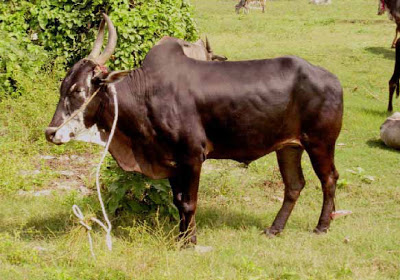
We had over 120 breeds of cattle in this country. Today, only 37 are left. Tamil Nadu had six cattle breeds earlier and now it has almost lost the Alambadi breed.  The remaining breeds are Kangayam of Dharapuram region, Pulikulam around Madurai, sivaganga region, Umbalacheri famous for its short legs making it easy to work in delta regions of Tamil Nadu, Bargur in hills of Erode district and Malai Maadu in theni district. There are a few more minor breeds without proper documentation. Most of these are on the verge of extinction.  One cannot ignore the participation of local community in biodiversity conservation.  

With no alternative in place for improving the status of native breeds, Banning Jallikattu as a whole will lead to extinction of native breeds and indirectly encourages imported cattle based dairies and slaughter house. It Directly, force the farmers to go for Imported breeds for which Artificial Insemination and other government sponsored breeding programme are easily available.


pulikolam.png
Pulikulam breed ; source: tamilnaducattle.Blogspot.com

alambadi.jpg
Alambadi breed; source: tamilnaducattle.Blogspot.com


Jallikattu - matter of Science:

Jallikattu is is nothing more than a selection of healthy bulls for servicing the cows.  Stud bulls are reared by people for jallikattu. The ones that win the jallikattu are much in demand for servicing the cows. Small farmers cannot afford to keep stud bulls, so each village has a common temple bull which services the cows of the village. Jallikattu is the event where bulls are bought and exhibited. The ones which are most agile (and virile) are preferred by farmers. The calves from such bulls are in demand. This is a traditional way of preserving the gene pool.

Jallikattu - matter of Politics:

It is not confined with AIADMK, DMK, BJP or congress. In this Globalised era, every political ploy is hooked together with local and international politics.  Literally politics today is run by corporates and business group.  Now, Western countries shift towards protectionist policies like Brexit, gain of Trump, etc. And developing countries are slowly accepting the principles of Globalisation and Capitalism.  Defending of Globalisation by Chinese President in World Economic Forum, 2017 is an example.  Fast food restaurant chain like KFC, pizza hut, etc., Multinational beverage industries like Coco cola, Pepsi, etc., beyond depleting their resources, decide what people in developing countries drink and eat.


If we give up our native breeds and import foreign breeds, multinational commercial companies will command over the dairy industry in India.  Dairy lobbies are much bothered of native cattles and their A2 milk. Similarly, there is a huge demand for Bos Indicus variety beef in the Gulf, Malaysia and Western countries. It is considered an exotic and healthy meat, just like country chicken.  Here the corporate string is clear, they intend to establish a dairy market in India and also to make India as an exporter of beef to fulfill their needs.

Marina; source: livemint


Narrowing down of “leaderless” protest in Marina beach, alanganallur and all over Tamil Nadu to just a matter of Tamil pride will interpret wrong solution.  Like “Arab spring” of middle east it will turn to a great Revolution over entire India if the State ignores the real interests of Youth.  Complete ban on Jallikattu will not bring solution, rather government should come out with regulatory mechanism to care native breeds for the welfare of its citizen.

To most of the world, this is just a dirt. To a farmer it's potential.
To most of world, this is just a sport. To a farmer it's lifeblood.

(M. Ram Sundar is a Horticulture graduate.  He is interested in writing and reading books. He is also the admin of IMoT forum. sundar.ram94@gmail.com)

Also read: ஏறுதழுவல் - அரசியலும்... அறிவியலும்...

Thursday, 12 January 2017

Digital India 2016 - A glance.  By Pavithran

Digital India is an giant leap for Indian society. Though the Scheme launched in  July 1 2015, many major initiatives of government and demonetization made “digital India” a buzzword in 2016.

As by Our P.M. Modi, “If we have to build the nation we have to start from villages”. There are still some areas without mobile network coverage, poor accessibility to banks, poor literacy rate and English knowledge. So there are chances for “digital divide” within our geographical area.


Similarly, Reports suggest that digital banking in India is not safe or reliable, due to poor cyber security infrastructure and policy. In October 2016 there was a major hack of credit and debit cards that affected around 3.2 million cards of 17 major banks in the country. The recently launched BHIM App is also criticized for lack of basic security features. The other challenges include poor smartphone penetration (only 34.8%), huge unorganized labour workforce, uninterrupted power supply for smooth e-transactions. Shortage of Point of sale machines and reliability of digital economy in Natural disasters like Vardah cyclone pose questions.

Digitisation in the current scenario can not be avoided as the world shifts to digital mode much faster. And there are many advantages in Digital Economy both directly and indirectly. The main advantages include prevention of corruption, black money and tax evasion. It prevents stagnation of money and fastens circulation.

As 120 million peoples of India are daily associated with paper documents the need of paper is increasing which leads to the various negative environmental consequence.  It also reduces travelling to get government services (by online submission of documents, digital signatures, video conferencing), thereby reducing vehicular pollution. So Digital India has Environmental benefits too.

It also put forward transparency and accountability in governance system. For example, Mygov app which act as interface between citizens of India and the government. Even normal layman can give his suggestions to the government. In a democratic system engagement of citizens in decision making is a key step. And it can be achieved through e-governance.
 
And public participation in policy making is increased with the digital social media platforms. Obviously, the Most innovative citizens management award Platinum Icon has been received by Mygov initiative and Coimbatore municipal corporation receives silver icon. There are many state government schemes such as amma e sevai maiyam in Tamilnadu, MeeSeva in Andhra Pradesh, Bhoomi project in Karnataka which gives access to various services to masses digitally.

Reports says that by 2020 internet users will be doubled to 750 million, in which 75% will be coming from rural areas. Making India to overcome US in the penetration of internet. This gives a positive note in delivery of digital services by Government.

In the whole, Digital India needs more time and it can not be achieved in a short time. Good initiatives of government should be put forward with better planning and execution to reach out every citizen of the country.

(Pavithran is a graduate in Agriculture. He is interested and passionate towards Politics.  sripaviips5@gmail.com)

Image source: digitalindia.gov.in,mygov.in

Wednesday, 11 January 2017

Microplastics and Macro Threat


Microplastics are small plastic pieces less than five millimeters long which can be harmful to our ocean and aquatic life.  As per  the estimate in 2014, around 2,70,000 tonnes of Microplastics were floating over ocean surface and the number is slowly increasing.The impact of microplastics is increasing over the years, It first affected Water ecosystem and now it had entered into human environment and food stuffs.

When Microplastics dissolve in seawater through pollution and poor waste disposal mechanisms, it absorb the harmful toxins. Sometimes it become bead like form, called as microbeads. These Microplastics and microbeads are consumed accidentally by zooplankton, which in turn is consumed by larger fishes, prawns and other marine organisms. It affects the life of marine organisms by damaging digestive tract, body parts and reproduction. Humans upon consuming those marine food stuffs can also get affected by these Microplastics.

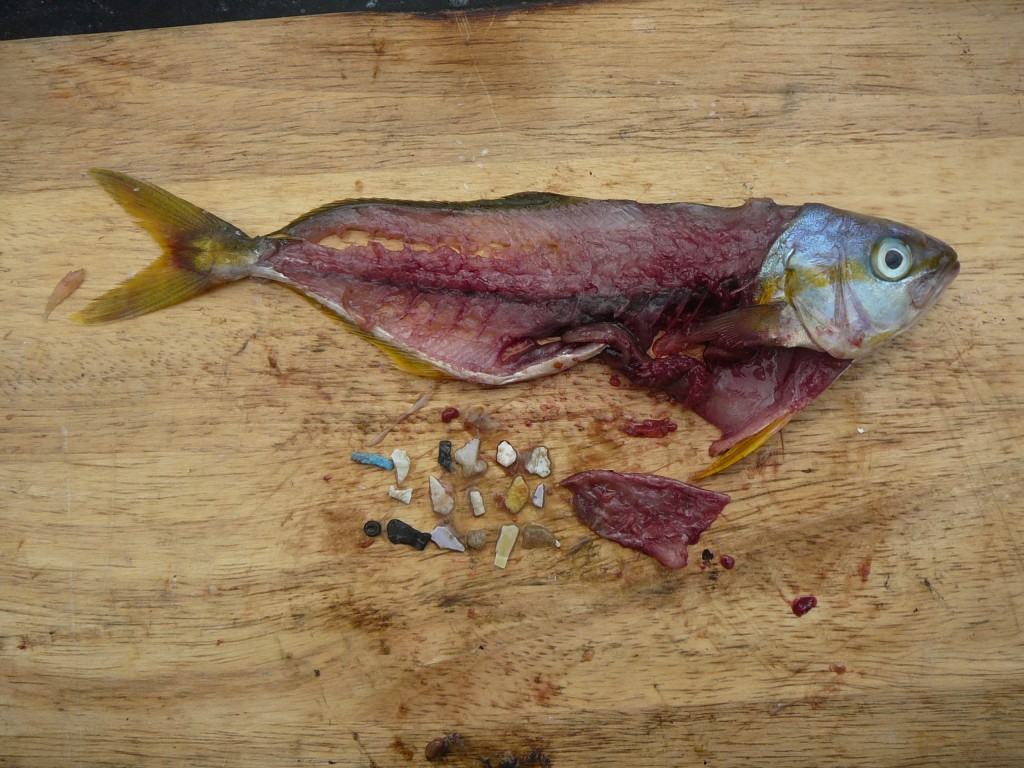
Source : Askhrgreen.org
More than a quarter of all fish now contain plastic, according to a recent study which analysed the guts of fish sold at markets in Indonesia and California.


Sources of Microplastics :
  • Cosmetics
  • Synthetic cloth material
  • Throwing of plastics
  • Other solid waste


Microbeads are very small pieces of plastic in products such as facial scrubs. Some are visible to the naked eye, but others are as tiny as one micrometre.  Sphericity and particle size uniformity create a ball-bearing effect in creams and lotions, resulting in a silky texture and spreadability. Smoothness and roundness can provide lubrication. Colored microspheres add visual appeal to cosmetic products.


Source: indiegogo.com


Microplastics and India :
The US ban covers cosmetic products with plastic microbeads, including toothpaste, soap and body washes. The UK also plans to ban microbeads from cosmetics by end of 2017.

It is estimated that the per capita consumption of microplastic in America is approximately 2.4 mg per person causing 263 tonnes of microbeads waste emission per year.  The said consumption in India would be much higher owing to larger population.  Which necessitates the Government intervention in this matter.

In India, In an application seeking a ban of these pollutants the National Green Tribunal on March 2016 issued notices to the Union health, environment and water resources ministries seeking their comments on what has been done to identify and curb this growing threat.


Also in the Plastic waste management rules, 2016 the Government put forward New new measures to manage Plastic waste by including Producer responsibility and delegating more role to local government bodies.


   Thus, there should be more awareness to consumers about usage of Microplastics in their daily products.  Producers should be made accountable for the scientific disposal and find good alternative eco friendly natural products. Government across borders should join hand to ban such products to achieve the Sustainable development Goals 2016-2030 particularly to conserve life below water (Goal 14), to ensure responsible consumption and production (Goal 12).

-Ram Sundar.M
(Ram Sundar.M is a Horticultural graduate, interested in reading books. He is also the admin of IMoT forum. sundar.ram94@gmail.com)

Contact us

Name

Email *

Message *